Showing posts with label eco-friendly. Show all posts

Thursday, June 12, 2014

Natural Living: Start Small

Many people have asked me, especially recently, how they can make the big switch to the natural life.  I try to answer specific questions, but the conversation usually ends with me saying, "Yes, you can do this.  Just start small!"

I would LOVE to be able to say that I only eat organic food that I've grown or raised myself, that I own nothing made outside of the US, that I produce my own electricity, that I have zero chemicals in my home, and so on and so on.  But I'm not there yet (and probably won't ever be).  What I am doing is educating myself and always trying to "do a little better."

Here's how my family has progressively changed our lifestyle over the last 8 years:

1. Ate a little healthier (in stages).

  • Bought fruit instead of processed snacks.
  • Cooked supper at home more often.
  • Stopped eating fast food.
  • Stayed on the outer aisles of the grocery store.
  • Eliminated foods with chemicals (such as dyes, flavorings, and preservatives).
  • Reduced (would like to eliminate) processed food.


To help make healthier choices, ask yourself: Is it nutritional and is it natural?

Eat nutritional, natural food.

2. Switched to organic and fair trade foods (first produce and milk, and then expanded from there).


Look for the USDA Organic symbol.


3. Eliminated Teflon-coated cookware.  We use ceramic and cast iron skillets.

4. Started growing our own produce.  We started with easy perennials, like strawberries and asparagus, in small raised beds and expanded from there.

5. Constructed a rain barrel.

6. Reduced waste. We started reusing things like Ziploc bags and food containers.  We started recycling and composting.

Reduce. Reuse. Recycle.


7. Switched to natural and organic products.

  • Tom's toothpaste, bar soap, and deodorant.
  • Mrs. Meyer's liquid handsoap.
  • Dr. Bronner's castille soap for cleaning.
  • Seventh Generation laundry and dishwashing detergent.
  • Burt's Bees and Nature's Gate shampoo.
Tom's is a popular brand.

8. Began buying American-made products.  (This has been the most difficult.)

9. Began raising our own meat.  We are in the very early stages of this.


There are plenty of people out there that are completely self-sustaining.  I am pretty sure I won't ever get to that point just because I'm too lazy.  I don't see myself grinding my own flour or making my own soap, but who knows...

So, my final advice is this: If you are interested in living a more natural life, pick what's important to you and focus on that one thing first.  Don't get overwhelmed in trying to make a drastic overhaul at once.  Start small!

Friday, June 6, 2014

Responsible Popcorn

Friday night means one thing in our house: MOVIE NIGHT!  Our movie nights are always the same...the sleeper sofa is pulled out, popcorn is made, and Sprites are poured.  It's a tradition we started years ago, and now, the boys won't let us miss it!  We ALL look forward to relaxing after a busy week of activities.


Popcorn and Sprites are in no way healthy, but everybody deserves a treat!  And even a treat like popcorn can be made naturally.  Here's how we do it:

First, we use an air popper.  An air popper is not only healthier, but it also adds a lot of excitement to the popping process.  The boys go crazy watching the popcorn puffs shoot out of the machine!

We love our Presto Poplite air popper!

Also, we choose natural, unflavored kernels.  (If you can find organic, great!)

Organic kernels are a wise choice.

If plain ol' popcorn is too boring for you, there are many natural ways to flavor it.  The boys' favorite topping is melted organic butter and a touch of sea salt.  My favorite topping is a tiny bit of extra virgin olive oil and ground peppercorns.  If you like a sweet kettle corn, try a little coconut oil, a touch of sea salt, and a little sugar (all organic of course).


So I debated on whether or not to go into why microwave popcorn is so bad for you since all I could really do is copy information from other websites.  But I didn't feel right about NOT spreading the information either, so here's the quick list of reasons to NEVER make it again:

1. The bags are lined with perfluorooctanoic acid
2. It contains chemical flavorings (such as Diacetyl)
3. It contains chemical preservatives (such as TBHQ)
4. It has more calories and trans fat

Furthermore, naturally cooked popcorn is more eco-friendly.  You can make just the amount you need, and there's no bag to throw away.  

Now, go enjoy some natural popcorn and don't forget to post your favorite popcorn topping recipes in the comments section.

Thursday, June 5, 2014

Weekend Project: Clothesline


I hope everyone who reads this will commit to putting up a clothesline in the next few weeks and using it whenever possible.  Building a clothesline that will look good and last a long time costs some money up front, but I guarantee you'll save money if you use it regularly in place of your electric dryer.  Plus, it's hard to beat the fresh scent of clothes that have hung on a clothesline.


Following are plans for building and installing a clothesline yourself.

Materials List:
four 8' long 4x4 posts
screws
four bags of concrete mix
four heavy duty hooks
four clothesline pulleys
100' clothesline

You will also need a tape measure, saw, drill, and something to mix your concrete with.

Trust me, if you take the time and spend the money to build and install your clothesline correctly, you'll be much happier with the finished product, and it will last a long time.  Keep in mind that a load of sopping wet clothes is actually pretty heavy, so the clothesline needs to be strong and secure.

Construct your two end pieces based on the dimensions below.  Both the horizontal and vertical pieces are notched out at the intersection.  Don't forget to insert the heavy duty hooks.


(Sorry I don't know the angles of the support pieces.  We just laid the posts on top of the 4x4 and drew lines with a pencil.)

Though it may not be the most attractive location, the clothesline needs to be in an open area, away from trees.  Place the end pieces about 24' apart (this allows for a 50' length of clothesline on each side).  Dig each hole to be 18" deep with a 20" diameter.  This may seem large, but trust me, you want the end pieces to stay straight and secure.


Place the end pieces into the holes with the hooks facing each other.  Fill the holes to the very top with concrete mix (after following the manufacturer's directions) and let dry.

Once the concrete has set, hang the clothesline pulleys and and the lines.  Pull the lines as tight as you can possibly get them.  Over time, the lines will loosen and sag, and you will have to re-tighten them periodically.


Now that you have a clothesline, here are just a few tips:

1. Use it!  It really is so much easier to toss a wet load in the electric dryer, but make yourself use the clothesline, and you'll always be glad you did.

2. Use heavy-duty clothespins.  There really is a difference in the cheap ones.

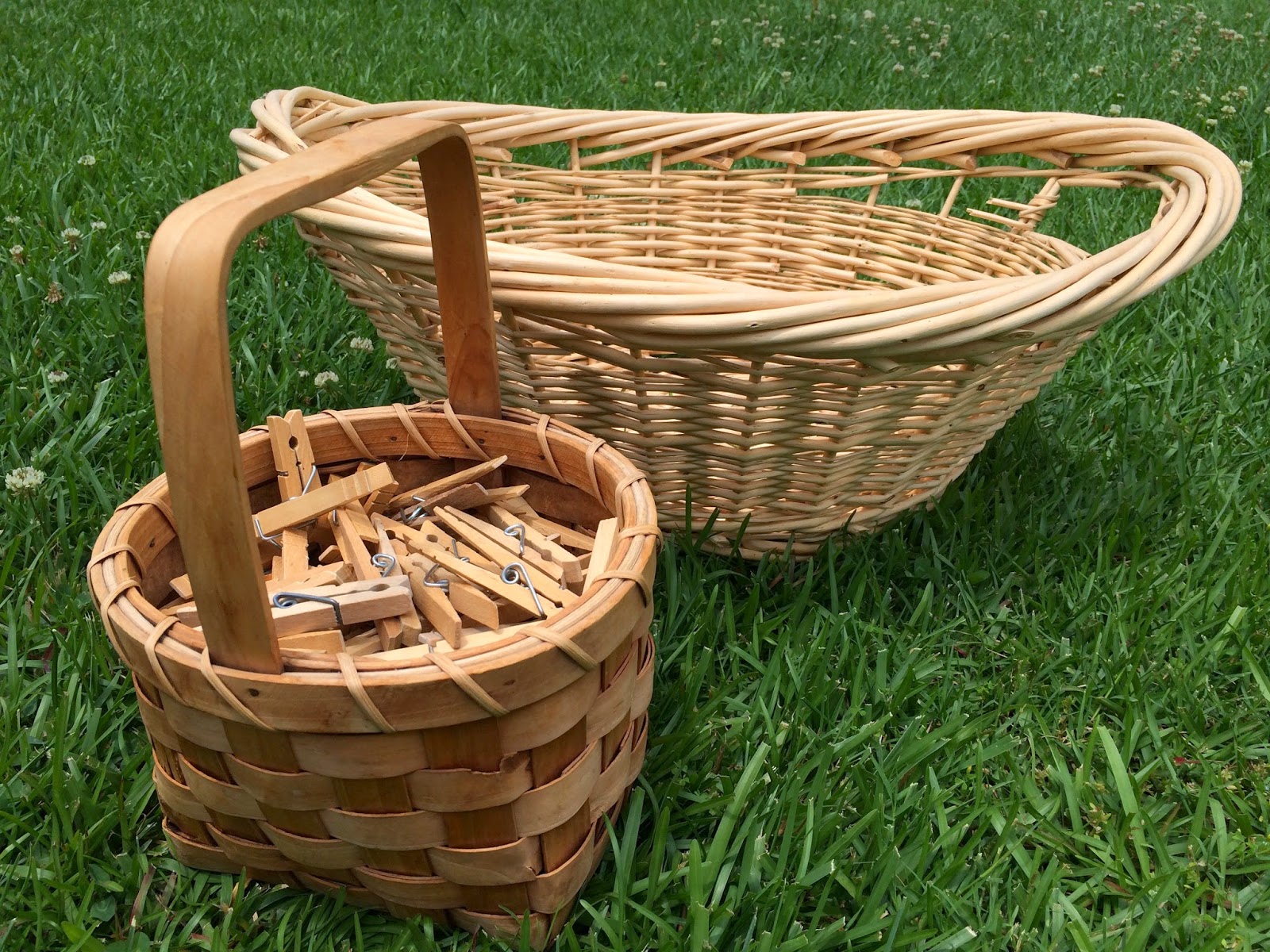
3. Keep your clothespins in a basket or tote that is easy to carry to and from the clothesline.

4. When hanging clothes, I usually stand in between my two lines and hang the adults' clothes on one line and the children's clothes on the other.

5. I also usually fold the clothes as I take them off the line.  By doing #4 and #5, once I have the clothes off the line, they are already folded and sorted and can go straight into drawers.

Heavy Duty Clothespins

Tuesday, June 3, 2014

Coffee Drinkers Unite

I have a confession: I am a coffee drinker.  I do my best to eat/drink healthy, but I currently have a coffee habit...one cup almost every morning.  I reassure myself with a study from a few years ago that said one cup of coffee per day may reduce my risk of melanoma.  Yeah, sure, that's what I'm telling myself.

So if you are like me and just don't want to shake the caffeine, I have some eco-friendly tips to assuage the guilt of coffee.  Here goes...

1. Reusable Filter. If you use k-cups, STOP!  Not only are those little plastic cups harmful, but they are also wasteful.  I love the convenience of the Keurig as much as the next person, and you can still use the machine, just swap the cups for the reusable filter.  You can purchase one anywhere Keurig machines and accessories are sold.  If you can find (and afford) a non-plastic one that fits your machine, that's even better.  Here's the one I use.
Yes, you lose some of the convenience because the filter has to be cleaned out, but it's safer, produces less waste, saves money, and the grounds can be composted.  I think all those benefits are definitely worth one extra minute of your time!

2. Organic.  Yes, you can buy organic coffee.  As with all your foods, look for the USDA certified organic seal.


3. Fair Trade.  Most of us are now familiar with the organic seal above, but fewer people think about purchasing fair trade certified products.  There are actually several different seals, but these two are the most widely accepted.


Why is fair trade important?  Fair trade ensures that workers, especially those in third-world countries, are paid fair wages, and Fair Trade USA promotes sustainable practices as well.  You can find out more at fairtradeusa.org.

The coffee I am drinking as I type this is The Organic Coffee Co.'s French Roast.  It costs around $8 at Publix (much cheaper than k-cups...rough math is .25 versus .55 per cup).


The Organic Coffee Co. is a division of the Rogers Family Company.  They have an amazing array of tea and coffee products, including kosher coffee.  They have a beautiful website with lots of information, so if you are a coffee connoisseur, you would definitely enjoy checking it out www.rogersfamilyco.com.

4. Smart Sweeteners. I drink it black, but if you don't want to, at least be smart with your sweeteners and flavorings.  Use local honey, organic milk, sugar that is also organic and fair trade certified, and organic, natural flavors.  As always, ditch the fake stuff!

Sunday, June 1, 2014

Cloth Napkins: Ditch the Disposables

Growing up, I always remember using cloth napkins for holiday and special-occasion meals.  As we got older, my mom began using cloth napkins for every meal.

A couple of years ago, after a meal at her house, I was thinking about how I loved using cloth napkins whenever we ate there, and it dawned on me...I can use cloth napkins at my house, too.  My mom has a bit of an obsession with table linens, so she gave me several of her sets of napkins.  We have been using them ever since.

One of the greatest things about using cloth napkins is that they are environmentally friendly.  Just think for a moment how many napkins and paper towels an average family of four will go through in one day...one week...one year!  It's mind-boggling!  Making the switch to cloth napkins can make a big impact on the amount of household waste a person has, so please, give it a try.

If you have access to a sewing machine, making napkins is probably the simplest sewing project there is.  Simply cut a square of fabric and hem the edges.  Standard dinner napkins are 20x20 inches, which is a little large for every day use.  My favorite set of napkins are these small, lightweight ones that are only 12x12 inches.


This set is also a favorite because the red and white gingham hides ketchup and pasta sauce stains quite nicely.


I think this set is the prettiest, but it is the most seldom used (for obvious reasons if you have ever seen my children eat!).  However, we do pull out the classic white napkins for special occasions, and I love seeing them on my farmhouse table.


Cloth napkins are fun as well.  Think of them as an accessory for your table.  You can buy or make them in all kinds of colors and patterns.  (My next sewing project is a set of Star Wars napkins per the kids' request.)

Cloth napkins add a "homey" touch to every meal, as well.  Something about cloth napkins just seems more inviting.  It tells guests that you're glad they're sharing a meal at your house and they're worth more than a disposable paper napkin.

I invite you all to make the eco-friendly switch to cloth and ditch the disposables!